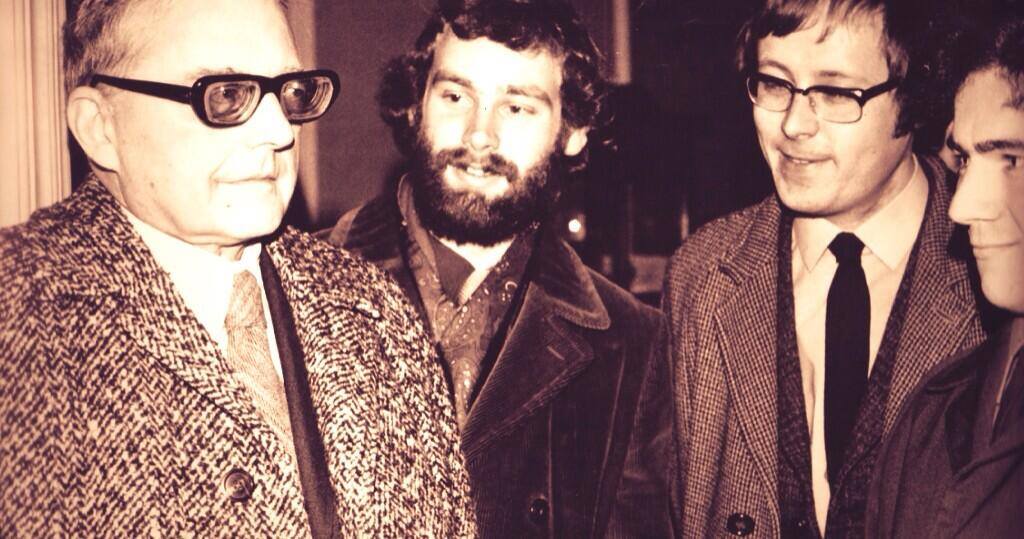
The Fitzwilliam Quartet is best-known for its relationship with Shostakovich and for making the first complete recordings of his quartets outside of the Soviet Union.
The Fitzwilliam Quartet initially achieved international recognition for their diverse repertoire and their well-documented personal connection with Dmitri Shostakovich. The composer reportedly told Benjamin Britten that the Fitzwilliam were his “preferred partners for my quartets”. Shostakovich entrusted them with the Western premières of his last three, and before long they had become the first ever group in the West to perform and record all fifteen. Gramophone described the recordings as amongst the '100 Greatest Recordings' of all time, and they were twice Grammy-nominated for Best Chamber Music Performance: Quartet No. 14, 1977; and Quartets Nos. 5 & 6, 1980. These discs, which gained many international awards, secured for the quartet a worldwide concert schedule and a long-term recording contract with Decca.
- Violin ILucy Russell
- Violin IIAndrew Roberts
- ViolaFrancis Kefford
- CelloUrsula Smith
IntroductionRead more
The quartet has recently embraced Francis Kefford on viola following the retirement from the ensemble of legendary founding-member, Alan George. After an incredible 56 years with the quartet, Alan leaves behind a cherished legacy. While Alan’s contribution will be sorely missed, the transition provides the quartet with an exciting opportunity to revise and reimagine its music-making. By continuing to add new music and fresh creativity to its core repertoire, the quartet is honouring the spirit of its foundations.
The Fitzwilliam Quartet was founded in 1968 by four Cambridge undergraduates and the group quickly achieved international recognition as a result of the members’ personal friendships with Dmitri Shostakovich and subsequent championing of his string quartets following his death. He entrusted the quartet with the Western premières of the last three, and before long it had become the first quartet outside of the Soviet Union to perform and record all fifteen. These discs, which gained many international awards, secured for the quartet a worldwide concert schedule and a long-term recording contract with Decca. While the Fitzwilliam Quartet’s pre-eminence in the interpretation of these works has persisted, the authority gained has also been put to the service of a diverse list of other composers from the late 17th century to the present day.
The quartet has appeared regularly across the UK, Europe, North America, the Middle and Far East and Southern Africa, and has made many award winning recordings for Decca, Linn, and Divine Art.
A long-term ambition to record Schubert and Beethoven on gut strings, following the success of previous discs on historical instruments, was initiated during the quartet’s 50th anniversary season in 2018 with recordings of Schubert’s late quartets; Beethoven’s Opp.131 and 135 are soon to be released.
The quartet continues to champion new works and has helped to bring about the addition of over 60 new works to the repertoire. These range in diversity from a jazz-fusion collaboration, with German saxophonist/composer Uwe Steinmetz and former Turtle Island Quartet violinist Mads Tolling, to quartets and quintets by Ian Stephens, Michael Blake and Liz Dilnot Johnson.
The Fitzwilliam Quartet has held various university residencies: at York for twelve years, Warwick for three, Fitzwilliam College, Cambridge, from 1998 to 2020 and at Bucknell (Pennsylvania, USA) from 1978-2016. The quartet’s current university work continues at Clare Hall, Cambridge and at St Andrews University.
The ensemble is also committed to working with amateur musicians, running its own course, Strings in Spring, at St Andrews University, and teaching regularly at Benslow Music near London. During the 2025/26 season, the Fitzwilliam Quartet will be presenting a series of programmes contrasting works by Beethoven and Shostakovich with works by female composers Amy Beach, Doreen Carwithen and Charlotte Bray. In so doing, the quartet is celebrating its rich history and carrying forward its traditions.
Alan George - a tributeRead more
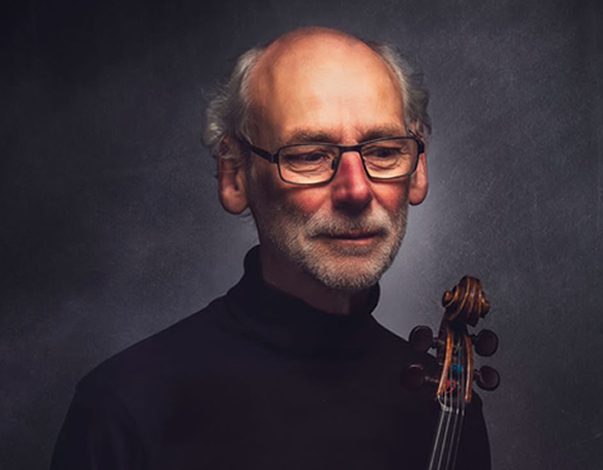
After an incredible 56 years with the quartet, Alan leaves behind not only a cherished legacy, but a claim to be the longest serving string quartet player in the UK, if not the world!
Alan studied violin with Colin Sauer at Dartington Hall, viola with Herbert Downes in London, and chamber music with Sidney Griller at the Royal Academy of Music. He won a scholarship to attend King’s College, University of Cambridge, where he became one of the founding members of the Fitzwilliam Quartet in 1968.
He served eleven years as principal viola with Orchestre Révolutionnaire et Romantique and has been principal viola with Southern Sinfonia. He is the author of four studies of Shostakovich’s chamber music and his work as an educator includes lecturer and chamber orchestra director at the University of York, where he became an honorary doctor of music in 2006. He also serves as a viola tutor at the Royal Northern College of Music and as a visiting lecturer and examiner and colleges and universities in the UK and abroad.
BeginningsRead more
The founding members of the FSQ first played together as undergraduates during their inaugural term at Cambridge University in autumn 1968. Their first concert appearance took place in Churchill College, Cambridge the following March, before their public debut at the Sheffield Arts Festival in June. After graduating in 1971 they accepted their first professional appointment, as Quartet in Residence at the University of York, following the eminent Amadeus Quartet. There, the group built a niche for itself in concert venues around Yorkshire and the rest of the United Kingdom. The FSQ was one of many quartets to have emerged under the guidance of Sidney Griller at the Royal Academy of Music during their residency at York University.
It was only a year into their residency at York University that the much documented association with Dmitri Shostakovich first catapulted the Quartet into the public eye. The composer travelled to York to hear the British première of his thirteenth quartet and this musical friendship (the composer’s own word!) prospered through correspondence, and the presentation of his final two quartets that he wrote in the years following. A planned visit to spend a week with the composer in Moscow however, was abandoned when he died in August of 1975. Benjamin Britten afterwards reported (just before his own death) that Shostakovich had told him the Fitzwilliam were his “preferred performers of my quartets”. Having premiered his last three quartets in Britain, the group soon became the first ever to record and perform all fifteen quartets; complete cycles were given in a number of major centres, including London, New York, and Montréal.
RecordingsRead more
The Shostakovich recordings (now reissued for a third time) gained many international awards including the very first Gramophone Award for chamber music in 1977 and inclusion in Gramophone magazine’s “Hundred Greatest-ever Recordings” (November 2005). The recordings secured a world-wide concert schedule and a long-term contract with Decca. All the recordings from that era are now available again on Decca’s “Eloquence” label.
The Quartet’s collaboration with Linn Records began in 2000 with Haydn’s Seven Last Words followed by critically acclaimed recordings of the Brahms clarinet quintet (with Lesley Schatzberger) and Vaughan Williams’s On Wenlock Edge (with tenor James Gilchrist and pianist Anna Tilbrook), the latter a 2008 Gramophone Award finalist. A live recording of Haydn’s Quartets Opp.1 No.6, Op. 71 No.2, and Op. 77 No.2 made in 2001 was recently reissued by the Divine Art Records label.
In 2012, the FSQ recorded the complete quartets of eminent geologist John Ramsay, CBE. In 2014, Absolutely! for string quartet, jazz violin and saxophone was released after a successful Kickstarter crowd funding campaign. This Jazz fusion album of music by German composer Uwe Steinmetz also features the Grammy-award winning violinist Mads Tolling.
In 2015, the FSQ collaborated with the St Salvator’s Chapel Choir and director Tom Wilkinson on Salvator Mundi: The Purcell Legacy (Sanctiandree Records). 2016 saw Bruckner’s String Quartet and Quintet with James Boyd, viola (Linn Records). A more recent release has been a double disc of chamber music by British composer Liz Johnson, now followed by the 50th anniversary discs of Shostakovich and Schubert, more details can be found on the discography page.
In February 2023, the quartet returned to Wyastone studios for the postponed second instalment of Ian Stephens’ Chamber Music. A pioneering project of music by one of our most important living composers: with the clarinet quintet and string quartet Springhead Echoes already in the can, they teamed up with the distinguished oboist Jonathan Small for Ian’s Oboe Quintet, together with his atmospheric string quartet North Country. The disc was released in February of 2025 by Divine Arts and more information can be found here on their website.
The quartet’s projected complete Beethoven cycle for Decca came to an unexpectedly early end in 1986, following the premature retirement of both Christopher Rowland and his successor Daniel Zisman. Nearly 40 years later, in the spring of 2024, they have followed Opp.127/133, 130, 132, and 135 with perhaps the greatest of them all – the C sharp minor (Op.131) – coupled with a re-make of his next and final quartet, the F major (Op.135). Following their release of Schubert’s own last quartet (the G major, D.887) on gut strings, they are proud to resume their exploration of works from 1826 Vienna with a further attempt to re-create the sounds and performing practices of that time.
RepertoireRead more
The FSQ is proud of its reputation for exploring less familiar repertoire, something that can give its concert programmes and discography a recognizably unconventional look. It has always been enthusiastic about promoting music of its time and the hotbed of new music at the University of York proved an inspirational starting point in its early years. Later, it was the University of York’s reputation for historical performance studies which encouraged the group to perform its earlier repertoire on period instruments.
More recently, as part of its 40th anniversary celebrations, the FSQ invited a number of composer friends to contribute to a series of new fantasias along the lines of those by Henry Purcell. This included Jeremy Thurlow, Jackson Hill, Carolyn Sparey, Duncan Druce, Liz Johnson, Uwe Steinmetz and most recently, since 2015, five fantasias by Marcus Barcham Stevens, the FSQ’s former second violinist! The extensive list of other composers with whom the FSQ has worked can be viewed on the Repertoire page.
ResidenciesRead more
Having succeeded the Amadeus Quartet at the University of York in 1971, the FSQ remained there, apart from a three year interlude at the University of Warwick (from 1974 to 1977) until 1986, enabling them to concentrate full time on quartet and academic work. In 1978 their university connections were extended to the USA, where they became Affiliate Artists at Bucknell University in Lewisburg, Pennsylvania. Their achievements were recognized there through Honorary Doctorates of Music conferred in 1981 by Shostakovich’s son, Maxim. In 1999, the FSQ began its ongoing residency at Fitzwilliam College, University of Cambridge.
In 2018, the quartet were appointed Quartet-in-Residence at the University of St Andrews Music centre. As part of the residency the quartet will coach student string players and scholarship groups, and mentor advanced players looking to enter postgraduate study or the music profession. The group will also participate in special projects with university groups such as Byre Opera and the Strings in Spring course. Michael Downes, the University’s director of music, said: ‘Since the Fitzwilliam first visited St Andrews in 2010, they have made an enormous impact on musical life in the university and the town. As one of the few leading British quartets to perform regularly on both modern and period instruments, their incredibly versatile musicianship has been displayed in projects as diverse as productions of Baroque opera, CD recordings with St Salvator’s Chapel Choir, and premiering contemporary works with principals from the Scottish Chamber Orchestra.’
In October 2021 the members of the Quartet were each elected Fellow Commoners “with enthusiasm!” by the Governing Body of Clare Hall, Cambridge: “awarded to members who make, and continue to make, a conspicuous and exceptional contribution to College Life” – thus confirming their new appointment as Resident Quartet at the College. They began active work there with a concert on 8 January, 2022, which included Beethoven’s visionary C sharp minor Quartet (Op.131).
TouringRead more
Highlights over the past few years have included participation in the making of an international dance film in Munich. There, the FSQ played music from the last three Shostakovich quartets; the choreographed dance featured a Japanese dancer and an Austrian poet. The FSQ has also made bi-annual visits to St Petersburg, Russia, where concert venues included the the Rimsky-Korsakov St Petersburg State Conservatory, Pushkin’s House, the Sheremetev Palace, the Summer Palace at Peterhof, and Agora, the former home of Modest and Pyotr Tchaikovsky. For most of its career the FSQ has made regular trips to the USA, where latterly it performed in Lorin Maazel’s private concert hall at his farm in Virginia. In 2008 the FSQ played for the first time in Newfoundland amid mid-winter snows, performing there again in 2012 at the Tuckamore Music Festival in St. John’s and in 2015 at the Wintertide Music Festival in Corner Brook.
The FSQ has featured at several Martin Randall Travel concert venues, including the complete Haydn Strings Quartets at Taunton in 2009 and two archaeological cruises from Athens to Istanbul when they performed in a number of ancient amphitheatres including that at Ephesus. Recent overseas ventures have taken the group to Italy and South Africa, where they played concerts in Cape Town and Pretoria, and recorded works by the Cape composer Michael Blake. They have since performed at the Chateau Bourglinster in Luxembourg and in Israel for the Eilat Music Festival.
Shostakovich and the Fitzwilliam QuartetRead more
The Fitzwilliam Quartet has long cherished it’s unique relationship with Dmitri Shostakovich, indeed, apart from the Beethoven Quartet in Russia, no quartet has ever had a closer relationship with the composer. This connection has been honoured, maintained and nurtured over the extraordinary 57 year history of the group and each successive generation of players. To this day, the members of the quartet continue to be deeply affected by Shostakovich’s voice – which lies within the heart of his quartets – and which speaks with searing truth, and an inescapable power to communicate across boundaries.
There will soon be an entirely new section of this website dedicated to the history of the quartet’s relationship to Shostakovich but, as a compliment, we highly recommend an excellent new article in The Strad written by the eminent musicologist Michael Downes, detailing how the original members of the quartet met Shostakovich in York in 1972 and performed his String Quartet no.13 with the composer in attendance.